- Written by Kyle Fletcher
- Published on October 1, 2026
Most commercial property owners searching for Denver safety bollards end up with the wrong product because no contractor took the time to walk them through the actual decision. They get a generic quote, a standard install, and a bollard that may look right but doesn’t match the real threat or the way their site operates. At Andrew-Thomas Contractors, we’ve been installing safety bollards and commercial fencing across the Denver Metro since the company was founded in 2006, and the most common problem we see isn’t a bad product. It’s a mismatch between what was installed and what the property actually needed.
This guide is a practical selection tool. We’ll walk you through the main bollard types, the site conditions that matter in Denver specifically, and a decision framework you can apply to your own property before you ever pick up the phone.
The Short Answer: Match the Bollard to the Threat
Choosing the right bollard comes down to four factors:
- Threat type: Vehicle intrusion, parking damage, or traffic delineation
- Site conditions: Soil, pavement, and freeze-thaw exposure
- Access needs: Fixed versus removable versus flexible
- Aesthetic or code requirements: Your property must meet
Get those four things right and the bollard selection follows naturally. Skip them and you’re guessing.

Why the Wrong Bollard Creates New Problems
Generic recommendations from Denver fencing contractors who haven’t studied your site lead to predictable mismatches. A flexible delineator post gets installed where a fixed steel bollard is needed, and the first time a delivery van drifts into it, nothing stops. Or a permanent cast-in-concrete bollard blocks the fire department’s access corridor because no one checked the access requirements before install. Both errors cost money to fix and neither was necessary.
We regularly work on commercial properties where a previous contractor installed the wrong bollard type, either because they defaulted to what they had on the truck or because they didn’t ask the right questions. The site looked protected, but it was not. Our approach starts differently: every recommendation comes after a consultation that looks at the actual application, the vehicle traffic on that specific site, the access needs, and what local requirements apply.
If you would like to talk through your property before committing to anything, schedule a free consultation with no deposit required. We won’t recommend a bollard type until we understand what you’re protecting against.
The Main Types of Safety Bollards for Commercial Properties
Four bollard categories cover the majority of commercial applications in the Denver Metro area. Each one has a distinct purpose and performs well in the right situation. Put it in the wrong situation and it either fails to protect or creates an obstacle you didn’t intend. Here is what each one actually does.
- Fixed steel bollards: For high-threat perimeter and storefront protection
- Removable bollards: For access control without sacrificing security
- Flexible and reboundable bollards: For traffic delineation and low-speed guidance
- Decorative bollards: For properties where appearance and function both matter
Fixed Steel Bollards: High-Threat Perimeter and Storefront Protection
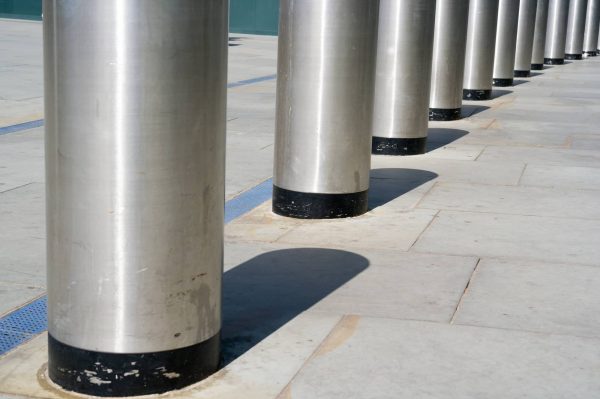
Fixed steel bollards are the standard choice for storefronts, building perimeters, restaurant facades, bank exteriors, and building corners where a vehicle must be physically stopped. They’re cast into a concrete foundation, which means the post and the footing work as a system. That load-bearing foundation is what gives a fixed bollard its stopping capability. A surface-mounted alternative can’t replicate it.
These are the right choice when the opening should stay closed to vehicles permanently. Retail storefronts with parking directly adjacent, drive-through lanes where a vehicle could cut the corner, and warehouse entry points near structural columns all fit this profile. Where they aren’t the right call is any opening that needs to accommodate vehicle or equipment access. A fixed post in a loading dock entrance creates a problem you’ll notice on the first delivery.
Denver adds one specific consideration: foundation depth matters more here than in warmer climates. Our freeze-thaw cycles cause frost heave, and a bollard that’s anchored too shallow will loosen over time as the ground moves around the footing. We account for this on every install, though we don’t quote a single depth number because the right depth depends on the soil and the site.
Removable Bollards: Access Control Without Sacrificing Security
Removable bollards are built for locations that need protection during certain hours but require open vehicle access at other times. The right applications include:
- Loading docks that operate during business hours but need to stay clear for early-morning deliveries
- Event venues that close vehicle access during events and open it during setup
- Shared parking areas with fire lane compliance requirements
The post locks into a ground sleeve, and when access is needed, it comes out with a key or a tool and gets stored until it goes back in.
The sleeve-and-lock system is reliable when it’s installed correctly. The detail that generic guides consistently miss is drainage. Denver’s freeze-thaw cycles mean water can enter the sleeve, freeze, expand, and either lock the post in place or heave the sleeve out of the ground. We design removable bollard installations with drainage in mind from the start. A sleeve that traps water is a problem waiting to happen the first cold week of November.
If your property has fire lane compliance requirements or seasonal access needs, removable bollards solve both. The key is making sure the installation handles Colorado’s winter conditions, not just the mechanical function of the post and sleeve.
Flexible and Reboundable Bollards: Traffic Delineation, Not Vehicle Arrest
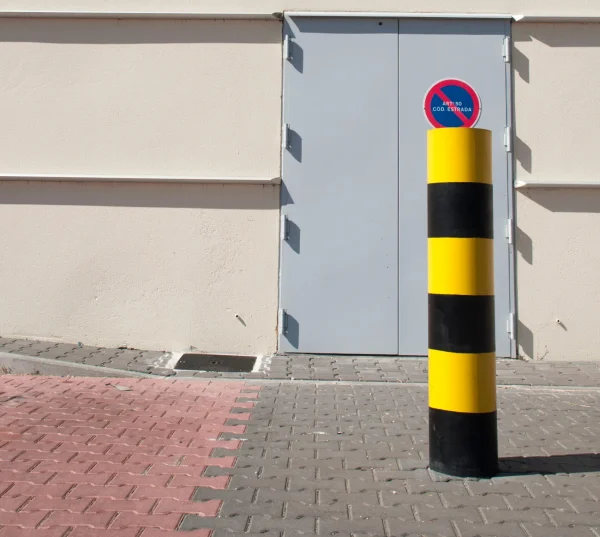
Flexible and reboundable bollards aren’t a vehicle-arrest solution. They’re designed for traffic delineation and low-speed guidance: parking lot lane markers, pedestrian pathway boundaries, cart corral edges, and drive-aisle visibility. When a vehicle strikes one, the post bends or deflects. That’s the design. It means a driver gets a visual cue and minor contact feedback, not a physical stop.
The mismatch we see most often is a commercial property using flexible bollards to protect a storefront or a building corner where a fixed steel post is actually needed. Flexible bollards are sold at a lower price point and are faster to install, which makes them appealing. But if your risk is a vehicle making contact with your building, a flexible post won’t stop it. It will bounce back after the fact while the damage is already done.
Use flexible bollards where you need visual guidance and low-speed parking control. Don’t use them where you need a vehicle stopped.
Decorative Bollards: Aesthetics With Functional Security
Decorative bollards are the right choice for retail districts, office parks, restaurant patios, and mixed-use developments where the bollard needs to fit the property’s appearance without looking industrial. They’re available in a range of finishes and profiles. Decorative doesn’t mean weak: a quality decorative bollard can be cast-in-concrete with real vehicle-arrest capability. The appearance is in the finish, not the foundation.
The question worth asking before you specify a decorative bollard is whether it actually meets the protection standard your application requires. Some decorative options are designed purely for visual delineation. Others are built to stop a vehicle. We can help you match the appearance your property calls for with the functional protection it actually needs, rather than choosing one at the expense of the other.
Denver-Specific Installation Factors That Generic Bollard Guides Miss
Most bollard selection guides are written for a general audience. They cover product types and applications reasonably well, but they leave out the installation variables that make the difference between a bollard that holds up for fifteen years and one that needs attention after the first winter. Our 18+ years of installation experience across the Denver Metro area has taught us four factors that belong in every commercial bollard conversation in this market.
- Freeze-thaw cycles: Cause frost heave and loosen shallow foundations
- Snow removal equipment: Contacts bollards in parking lots and loading areas each winter
- De-icing chemical exposure: Accelerates corrosion on exposed steel
- Soil conditions: Vary significantly across the Denver Metro and affect anchoring method
Freeze-Thaw Cycles
Denver’s temperature swings between seasons, and sometimes within a single week, put real stress on bollard foundations. Frost heave occurs when moisture in the soil freezes, expands, and pushes upward on anything embedded in the ground. A bollard foundation that doesn’t account for local frost depth can shift, loosen, and eventually compromise the post’s stopping capability. This is one of the reasons we start with a site evaluation rather than a standard spec. The right footing design depends on what is underfoot and how that specific location drains.
Snow Removal Equipment Exposure
Bollards in parking lots and loading areas get hit by snow removal equipment. Plow blades, snow blowers, and skid steers are part of winter operations on almost every commercial property we work on. Finish selection and post gauge matter here. A bollard with a thin-walled post or a finish that can’t handle repeated scraping will show wear quickly. We factor in how a property manages snow removal when we’re specifying a bollard for a parking lot or dock area.
De-Icing Chemical Contact
Salt and chemical de-icers are applied on Denver commercial properties through most of the winter. They accelerate corrosion on exposed steel, and the rate depends on the coating and the base material. This isn’t just an aesthetic issue. A post that corrodes from the base up loses structural integrity over time. Finish and coating selection for a Denver installation is a functional decision, not just a visual one.
Soil Conditions
Local area soils range from clay-heavy Front Range ground that holds moisture and swells to sandier profiles that drain faster but offer different anchoring characteristics. The right anchoring method depends on what is underfoot at your specific site. We assess soil conditions as part of the consultation because a foundation design that works in one part of the Metro may not be appropriate two miles away.
How to Match the Right Bollard to Your Commercial Property
Run through these five questions before you finalize a bollard type. They’re the same questions we ask at the start of every commercial bollard consultation, and they cut through the product selection fairly quickly.
- What is the primary threat? Accidental vehicle intrusion from a distracted driver, parking lot damage from slow-speed contact, operational access control during certain hours, or visual delineation and traffic guidance. These lead to different bollard types.
- Does the opening need vehicle or equipment access? If yes, fixed bollards close it permanently. You need removable or retractable options depending on how frequently access changes.
- What do local requirements say? Check fire department access corridors, ADA pedestrian clearance requirements, and permit requirements for your jurisdiction. Bollards that conflict with any of these will need to be relocated or replaced.
- What are the site conditions? Pavement type, soil, freeze-thaw exposure, and de-icing chemical use all affect the right installation method. A bollard spec that ignores these isn’t a complete spec.
- Does the bollard need to match the architecture? Properties in retail districts, mixed-use developments, and office parks often have appearance requirements. Decorative options exist that meet functional standards, so aesthetics don’t have to mean a compromise on protection.
If you’re working through these questions and want a second set of eyes, reach out for a free estimate. There’s no deposit required, and we won’t push a product type before we understand your answers.

Common Bollard Placement Mistakes on Denver Commercial Properties
Getting the bollard type right is half the job. Where you put it matters just as much. These are the placement errors we see most often when we’re asked to evaluate or redo a commercial bollard installation.Spacing that lets a vehicle through
Bollards spaced too far apart create a gap a vehicle can pass through, which defeats the purpose. The right spacing depends on the vehicle threat profile for that location. Ask yourself: what is the widest vehicle that needs to be stopped, and is the spacing narrower than that vehicle’s track width? If you haven’t asked that question, the spacing may be wrong.Blocking fire department access
Fire access corridors have clearance requirements, and bollards placed without coordinating with those requirements create compliance problems. A property that installs bollards across a fire lane may face a requirement to remove and reinstall them at cost. Check with the authority having jurisdiction before finalizing placement near any fire access route.ADA clearance violations
Bollards placed in pedestrian pathways need to leave adequate clear width for accessibility compliance. A bollard positioned to deter vehicles that also narrows the pedestrian path below required clearance creates a different kind of liability.Protecting the wrong location
We’ve evaluated properties where the bollards were placed along a wall that wasn’t the primary intrusion risk, while the actual vulnerable corner, the one where a vehicle could most easily impact the building, was left unprotected. The bollard placement followed a visual pattern rather than a threat assessment. Walk the property and identify where a vehicle could actually make contact with a structure or a person.When Bollard Repair Makes More Sense Than Replacement
Bollard repair in Denver is often the right call, and we’ll say that plainly even though a full replacement generates more revenue. Repair is usually the correct response in these situations:
- Post damage with an intact foundation: If a vehicle strikes a post and the sleeve and foundation remain structurally sound, replacing the post section is faster, less disruptive, and less expensive than breaking out the foundation and starting over.
- Surface rust and finish damage: Treating and recoating a post with surface corrosion extends its service life without the cost of a full replacement.
- Loosened removable bollard sleeve: A sleeve that has shifted from frost heave or soil movement can often be re-set and re-grouted rather than excavated and replaced entirely.
Replacement is the right call in three situations: structural deformation from a high-force impact that has bent or compromised the post’s integrity, foundation failure from frost heave or soil movement that can’t be corrected by re-setting, or a bollard type that no longer matches the current risk profile of the property. If the original bollard was the wrong type for the application, repairing it just extends the mismatch. When you contact us for bollard repair that properties often need, we’ll give you an honest assessment of which situation you’re actually in rather than defaulting to the more expensive option.
Why Denver Commercial Properties Trust Andrew-Thomas Contractors for Bollard Installation
We’ve been doing commercial bollard installation in Denver, along with fence installation, fence repair, commercial fencing, and driveway gates, across the Denver Metro area since 2006. That’s 18+ years of field work on Colorado soil, in Colorado winters, on properties from Applewood to Parker and across the communities in between including Arvada, Aurora, Westminster, Centennial, Littleton, Lakewood, and Englewood. Everyone on our team has personally installed bollards and fencing in this market. You won’t be talking to a call-center rep who has never set a post in Colorado ground.
Andrew-Thomas Contractors is a BBB-accredited business, and we back every installation with a one-year workmanship and materials warranty. Depending on project scope, we typically don’t require a deposit. Payment is due only after the project is completed to your satisfaction. For commercial property managers and business owners who have been burned by contractors who take money upfront and disappear, that policy matters.
Our four-step process keeps every commercial bollard project on track:
- Initial Consultation: To understand your application and site conditions
- Approval and Scheduling: To document the scope and set a firm timeline
- Installation: By our experienced Colorado field team
- Service and Maintenance: Support if it’s ever needed after the project is complete
Safety bollards are also most effective as part of a coordinated perimeter. We install safety bollards alongside commercial fencing and driveway gates, which means one contractor, one consistent installation standard, and a perimeter that works as a system rather than a collection of separate parts.
Ready to Get the Right Bollard for Your Denver Property?
We start every commercial bollard project by understanding the application before we recommend a product. If you aren’t sure which bollard type fits your property, that’s exactly what the consultation is for. There’s no obligation and no deposit required.
Get your free estimate and we’ll walk through your site conditions, access needs, and protection requirements before we suggest anything.
If you’d like to review our full range of Denver commercial bollard services before calling, visit our Denver safety bollards service page.
For properties that need a complete perimeter solution, we also install commercial fencing and driveway gates across the Denver Metro area.

Written by Kyle Fletcher
Kyle Fletcher is the owner and CEO of Andrew‑Thomas Contractors, serving the Denver metro. In fencing since high school, he launched the company in 2006 and oversees estimating, scheduling, and quality checks on residential, commercial, and HOA projects. His team specializes in fence installation and repair, driveway gates, hand rails, and safety bollards, delivering work at or above industry standards. Clients know Kyle for clear communication and clean job sites—habits reflected in the firm’s A+ BBB rating and consistently strong Google reviews.